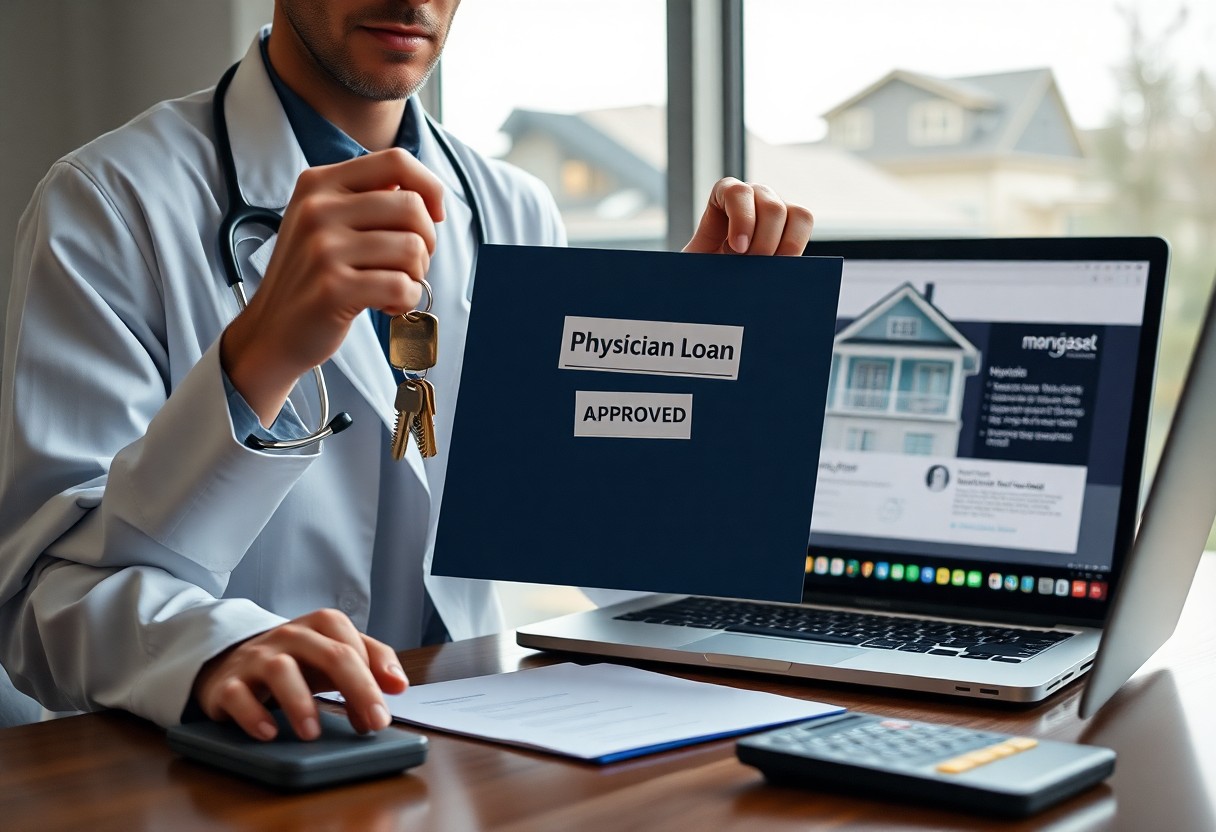

Just as your career accelerates, understanding physician loans lets you secure a home with tailored financing, low-to-no down payments, and flexible underwriting that suits medical professionals; this guide walks you through eligibility, benefits, lender selection, loan terms, and negotiation strategies so you can make informed decisions, avoid common pitfalls, and confidently navigate buying a home during residency, fellowship, or as an attending physician.
Types of Physician Loans
When weighing your options, you’ll commonly see conventional, FHA, VA, J.D. and other specialty loans, plus portfolio/private lender programs tailored to high-earning professionals. Many physician products allow 0-5% down, higher DTI limits (sometimes up to ~50-55%), and PMI waivers for borrowers with strong contracts. Compare rate differences of 0.25-0.75% and lender fee structures to pick the best fit for your timeline and debt load.
| Conventional Loans | Often 0-5% down for physicians, possible PMI waiver, works for conforming and jumbo sizes |
| FHA Loans | 3.5% minimum down, lower credit score thresholds (often 580+), mortgage insurance required |
| VA Loans | 0% down for eligible veterans/servicemembers, no PMI, possible funding fee applies |
| J.D. and Other Specialty Loans | Custom underwriting for professionals (residents, dentists, attorneys), flexible income validation |
| Portfolio / Private Lenders | Bank-held loans with bespoke terms: income-based seasoning, student loan exclusions, unique repayment options |
- Eligibility usually requires a signed employment contract or proof of future income.
- Down payments range from 0% (VA or some physician programs) to 20% for better rates on jumbo loans.
- This helps you shortlist lenders who will count future bonus/guaranteed income when qualifying.
Conventional Loans
You can access physician-specific conventional loans with as little as 0-5% down, often without PMI if you meet lender thresholds; many programs accept future income from signed employment contracts and accommodate higher DTI up to ~50%. For example, a resident accepted to a $300,000/year faculty position secured a 30-year fixed at a competitive rate with 5% down and no PMI.
FHA Loans
If your credit score is in the high 500s-low 600s, FHA loans let you buy with a 3.5% down payment and more lenient underwriting; however, FHA requires up-front and ongoing mortgage insurance premiums that increase monthly payment. Many early-career physicians use FHA to enter a market quickly while they build reserves or close on physician-tailored conventional refinances later.
In practice, FHA limits in many counties are lower than conforming limits, so high-priced purchases may push you toward jumbo or physician-specific conventional products; seller concessions up to 6% can offset closing costs. Use FHA if you need low down and flexible credit, but plan a refinance strategy once your income and credit history stabilize.
VA Loans
When you qualify through service, VA loans provide true no‑down financing with no PMI and often superior rates; you’ll still pay a funding fee (varying by service status and down payment) and must meet occupancy rules. Active-duty physicians or veterans commonly use VA to purchase $400k-$800k homes without a down payment, then refinance later if desired.
VA underwriting considers entitlement and residual income; some lenders combine VA benefits with physician underwriting to count future employment contracts. If you have full entitlement and a solid contract, you can often secure a competitive 30-year fixed with full leverage and lower monthly insurance expenses than FHA.
J.D. and Other Specialty Loans
Specialty loans for professions labeled J.D., D.D.S., D.M.D., or M.D. use tailored underwriting: lenders may exclude a portion of student loan payments, accept residency/fellowship contracts as qualifying income, and offer 0-10% down options. You benefit when a lender recognizes your career trajectory-example: a new attending with $250k projected income qualified for 95% financing based on a signed contract.
Underwriting on these specialty products often nets flexible DTI calculations, alternative documentation (employment letters, future compensation schedules), and customized rate adjustments for signing bonuses or relocation allowances. Shop multiple specialty lenders to compare how each treats deferred student loans and bonus income when qualifying your file.
Step-by-Step Guide to Applying for Physician Loans
| Step | Action |
|---|---|
| 1. Pre-Approval | Get a pre-approval letter using your contract/offer to lock purchasing power. |
| 2. Gather Documents | Assemble contracts, tax returns, bank statements, student loan docs and ID. |
| 3. Shop Lenders | Compare rates, PMI rules, loan limits and student-loan treatment across 3-5 lenders. |
| 4. Apply & Lock | Submit application, lock rate (30-45 days typical) and order appraisal. |
| 5. Close | Review Closing Disclosure, fund escrow and close-often 21-45 days from application. |
Pre-Approval Process
You start by submitting a signed employment or residency/fellowship letter, recent credit score and basic financials; many physician lenders prefer credit scores 680-740 and will issue pre-approvals valid 60-90 days after confirming DTI (often allowed up to 45-50% for doctors). A clear pre-approval shows sellers you can close and typically includes a conditional loan amount and estimated rate based on your profile and the loan product.
Gathering Required Documentation
You’ll collect your signed employment/offer letter, two years of tax returns or W-2s (if applicable), 2-3 months of bank statements, student loan statements showing payment status, photo ID, and any medical license or diploma; lenders often ask for proof of reserves equal to 2-6 months of mortgage payments for certain jumbo limits.
Order electronic copies and organize them in one folder: highlight start date, base salary, sign-on bonuses and contingencies in your contract, and pull an updated credit report to clear any surprises. Note that lenders may calculate student loan payments using the actual reported payment or a percentage of the balance (commonly 0.5%-1.0%), so provide lender-friendly documentation like payment plans or PSLF letters to minimize DTI impact.
Finding the Right Lender
You should solicit Loan Estimates from 3-5 lenders and compare APR, down payment rules, PMI waivers, loan maximums (physician programs often go to $1M+), and how they treat residency/fellowship income; small rate differences (0.25%-0.75%) can mean thousands over a mortgage term, so shop actively and track total costs, not just headline rates.
Ask each lender about turn-times (physician programs can close in 21-30 days), rate lock length, and sample scenarios-e.g., whether they allow 0%-5% down with no PMI up to certain limits-and request references or case studies of recent physician closings to confirm experience and predictable execution.

Important Factors to Consider
You should weigh credit score, debt-to-income, down payment, reserves and your employment contract when choosing a physician loan; lenders often value a signed attending contract and may be flexible on reserves. Many physician programs treat student loans and future income differently than conventional products, affecting qualification. Compare lender policies on PMI waivers, occupancy rules and property eligibility before locking in an offer. Perceiving these trade-offs helps you prioritize lender choice based on timeline, down-payment capacity and risk tolerance.
- Credit score and recent credit events
- Debt-to-income ratio and student-loan treatment
- Down payment amount and PMI rules
- Employment contract strength and start date
- Property type, occupancy and lender loan limits
Credit Score Requirements
Most physician loan lenders prefer a credit score of 700 or higher, though some accept 680 with compensating factors like a signed employment contract or a larger down payment. If your file includes recent collections or a thin history, adding a seasoned co-borrower or improving tradelines can move you from manual underwriting to automated pricing; scores above 720 typically secure the lowest rates.
Debt-to-Income Ratio
Lenders use DTI to gauge repayment ability; physician programs often allow higher DTIs-commonly up to 50-60% for residents or incoming attendings-compared with the typical 43-50% conforming threshold. Presenting a guaranteed future salary or lower documented student-loan payments can shift an otherwise marginal DTI into approval territory.
DTI is calculated by dividing total monthly debt payments (including estimated mortgage principal & interest, taxes and insurance) by gross monthly income; for example, $3,000 in debts plus a $2,500 mortgage on $15,000 gross income equals a 36.7% DTI. Lenders differ in student-loan treatment-some use the actual payment, others use 0.5% of the balance or the documented income‑driven payment-so get lender-specific calculations before applying.
Loan Limits and Criteria
Physician loan programs can be more generous on size and down payment: some lenders offer jumbo physician products up to $2-3 million with 5-10% down, while others stick close to conforming limits and standard seasoning rules. Purpose (primary residence vs. second home or investment) and property type materially affect pricing and eligibility.
Conforming loan limits in many counties fall in the $700k-$800k band, so a $1.2M purchase typically requires a jumbo physician loan or 20%+ down through a conforming lender. Additionally, lenders often exclude non‑warrantable condos and certain co‑ops, and they may cap loan amounts by investor overlays-verify max loan sizes and property acceptability early in your search.
Tips for a Successful Home Purchase
- Get a physician-loan preapproval first; many lenders approve based on future income and student loan deferment, letting you shop with confidence.
- Budget for 2-5% of purchase price in closing costs and 1-3% earnest money (on a $500,000 home, that’s $5,000-$15,000 earnest).
- Prioritize commute time, hospital affiliation, and resale in markets where young professionals drive demand, like suburbs near major medical centers.
- Assume that you can negotiate seller concessions up to about 3% of purchase price to offset closing costs or request a credit for minor repairs.
Working with a Knowledgeable Real Estate Agent
You should hire an agent who has closed multiple deals for physicians and understands physician-loan timelines, licensing relocations, and contract deadlines; an agent with 10+ doctor clients can time contingencies around start dates and coordinate lender and employer verifications, source comparable sales in medical neighborhoods, and advise on inspection waivers versus negotiated repair credits to protect your down payment and cash flow.
Negotiating Offers and Closing Costs
You can strengthen offers by using escalation clauses, flexible closing dates, or higher earnest money (1-3% typical), and by requesting seller-paid closing costs-sellers often accept up to 3% concessions; on a $400,000 purchase that’s $12,000 toward your fees, which can cover origination, title, and prepaid taxes if your lender allows seller credits.
In practice, offer strategy should match market heat: in a hot market, an escalation to 1-2% above competing offers plus a 2% earnest deposit often wins; in a buyers’ market, ask for a 2-3% seller credit to cover closing costs or buy-down points. Document requests clearly in the contract, lock your rate once contingencies clear, and verify lender limits on seller concessions to avoid last-minute surprises.
Pros and Cons of Physician Loans
| Pros | Cons |
|---|---|
| Low or no down payment (commonly 0-5%). | Sometimes higher interest rates or origination fees than the best conventional offers. |
| No private mortgage insurance (PMI) required on many products. | Fewer lenders offer physician programs, limiting competition and choice. |
| Higher loan limits (many lenders approve $1M-$3M+). | Eligibility often depends on specialty, residency status, or signed employment contract. |
| Flexible treatment of student loans and future income. | May require 3-12 months of cash reserves, depending on lender. |
| Higher allowable debt-to-income ratios (often up to ~50-55%). | Refinancing options can be limited or less favorable later. |
| Underwriting tailored to physicians speeds approvals. | Some programs add program-specific clauses or documentation requirements. |
| Enables early-career homebuying and equity building. | Not always the best value if you can make a large down payment and qualify for top conventional rates. |
Advantages of Choosing Physician Loans
Often you can buy with 0-5% down and skip PMI, saving several hundred dollars monthly on a $500k-$700k purchase; many lenders accept residency or a signed attending contract as qualifying income, permit DTIs near 50-55%, and offer loan caps commonly in the $1M-$3M range, so you can secure the home you need earlier in your career without waiting to accumulate a large savings cushion.
Potential Disadvantages to Consider
Many physician loans charge slightly higher rates or fees compared with the absolute best conventional products, and lender availability is limited, so you may face fewer competitive offers; additionally, strict program rules-like required employment contracts or reserve minimums-can complicate approvals if your situation changes.
Digging deeper, you should expect tighter program-specific underwriting: lenders may require written employment contracts, proof of specialty board track, or 3-12 months of reserves depending on loan size and your residency status. If you plan to refinance, note that not all lenders will refinance their own physician products at attractive terms, and switching careers or leaving clinical practice can reduce refinancing options. Always run side-by-side scenarios: compare total up-front costs, interest-rate differentials, and long-term savings versus a conventional loan when you have a substantial down payment or excellent credit.
Frequently Asked Questions
Top FAQs
Many physician loans let you put 0-5% down and avoid PMI, accept residency or fellowship income, and count deferred student-loan payments rather than the full balance when calculating DTI; lenders typically expect 3-6 months of reserves and may approve DTI up to ~45%. For example, a resident with $200,000 of loans qualified using deferred payments and purchased a $600,000 condo with 5% down. Ask lenders about rate overlays, loan limits (often $1-2M), and whether they require employment contracts.
Conclusion
Ultimately you can leverage physician loans to buy a home with minimal down payment, flexible underwriting, and competitive rates that reflect your earning potential; to benefit, compare lenders, verify program terms, maintain strong credit and documentation, plan for residency income and future moves, and work with a mortgage specialist who understands physician programs so your purchase is smooth and aligned with your financial goals.